Edwardian Era Ladies' Dresses - March 1905 The Delineator
8227 - Ladies' Bolero Waist (left) - One of the latest designs for a fancy waist is pictured at the top of the page in tan eolienne, combined with Renaissance all-over lace, and a plain girdle of tan peau de soie is a pleasing adjunct. A close-fitting lining serves as a foundation for the blouse, the back of which may be eased slightly if the sagging effect is unbecoming, and a front closing is employed. The bolero hangs free all around, or the fronts may be used alone. A pretty effect is given by turning back the fronts to give the effect of revers, although the pattern makes allowance for cutting them off and also for omitting the straps and fancy collar. A girdle and standing collar are worn. Two-seam sleeve-linings support full puffs, and are faced to form deep cuffs or cut off for long elbow length, flaring cuffs, turned up or down, as individual fancy may dictate, being added. This is known as the Monte Carlo waist.
Silk Batiste, chiffon, mousseline, crepe de Chine or Liberty satin are suggested, for the blouse, and peau de soie, veiling, fine broadcloth, cashmere, chiffon or panne velvet may be employed for the bolero, sleeves and girdle.
8234 - Ladies' Seven-Gored Skirt (left) - Some of the prettiest of the season's skirts are made with tuck-plaits, and a smart design of seven-gored shaping is here illustrated in dark-green serge. Short round and instep lengths are provided for, as well as round length, the entire lower edge in the medium sizes attaining a measurement of about five yards. Tuck-plaits arranged to give a wide kilt effect may have the stitching terminate at yoke or flounce depth, with corresponding stitching along the creased edges if desired. A yoke in fancy outline is a desirable feature, but its use is optional.
Wood-brown broadcloth will make up attractively for wear with a coat of the same material. Zibeline, cheviot, tweed, voile and cashmere may be used, and washable materials will also prove satisfactory.
8223 - Ladies' Blouse Waist (right) - A fancy waist of decidedly unique design is shown directly opposite in developments of figured silk and in pale-tan eolienne, with lace and velvet for relief. The back closing gives a youthful air to the mode, and the over-blouse is a pleasing feature. The latter is designed for any of three depths, and is supported by two straps at each side passing over the shoulders in suspender style, and giving it the name of the suspender bodice. A body lining serves as a foundation for the under-blouse, which is plain save for gathers at the waist and is made high in the neck with a standing collar, or cut out for pointed outline. A belt finishes the waist stylishly. CLose linings support the full puffs of the sleeves, with or without self frills, and are faced to form deep cuffs or cut off for three-quarter length.
A waist is suggested in tea-colored crepe Olga, with an under-blouse of tucked chiffon of the same shade, and suspender straps of velvet a shade darker.
Showing posts with label Ladies' Dresses. Show all posts
Sunday, December 9, 2012
Wednesday, November 14, 2012
Edwardian Era Ladies' Dresses - October 1904 The Delineator
Left - Waist 7896 is here shown with Skirt 7869, in cafe au lait voile with self ruffles and darker velvet, and with pendants and lace banding on the waist.
Right - White English embroidery provides stylish trimming for the shirt-waist of this pretty frock of plum-bloom nun's-veiling; the Skirt is 7910 and the Waist is 7895.
7896 - Ladies' Tucked or Gathered Waist - The popular back closing distinguishes the waist shown on the opposite page, in white mistral associated with Venise all-over lace. The shallow yoke in fancy outline is a pleasing feature, but is not always employed. The mode may be tucked or gathered at the front and back, and bloused all around or only at the front, and a standing collar is worn. Gathers or tucks may be introduced at the top of the sleeves, which are in full length with plain or pointed cuffs, or in three-quarter length. Body and sleeve linings are included, but need not be used, and a crush girdle-belt forms a stylish finish for the waist.
Pale-blue messaline with Limerick all-over would make a dressy waist. Crepe de Chine, messlinette, veiling, Liberty satin, voile, crepe de Paris and all soft fabrics are suitable for reproducing the mode, and a pretty embroidered design may be introduced on the yoke and cuffs.
7869 - Ladies' Seven-Gored Skirt - This graceful skirt of "1830" design is depicted in oyster-white albatross with silk folds in graduated widths, and with frills of lace. Seven gores are employed in its construction, and tucks or shirrings to any yoke depth may control the fulness at the top. When the tucks are used, a narrow space at the front is left plain in panel effect and an inverted box-plait is formed at the back. Provision is made for a long or medium sweep as well as for round length, and six yards is the measurement given the lower edge in the medium sizes. The use of the seven-gored foundation skirt is a matter of preference.
All the thin, soft, woollen materials, such as nun's-veiling, batiste, voile, lace etamine, canvas, crepe de Chine cloth and cashmere, and pliable silks, gauzes and washable fabrics are recommended.
7910 - Ladies' Skirt - Groups of "nun" tucks ornament the skirt here portrayed, which is one of the "1830" modes, and is shown in almond-green nun's-veiling. The upper portion is shaped by seven gores, tucked, shirred or gathered at the top, and has three tucks at the lower edge. A straight flounce, also displaying tucks, lengthens the mode, and is attached to the upper portion by gathers. Round and short round lengths are given, and in the medium sizes the lower edge measures about six yards and one-half. A foundation skirt composed of five gores may be used or not.
A skirt of this type in tan or brown voile will be pretty with a waist of the same material, similarly tucked. Mistral, eolienne, cashmere, crepe de Chine cloth, foulard, cheviot, etamine, wool crepe, serge, soft taffeta and satin are adaptable, and taffeta is generally employed for the foundation skirt.
7895 - Ladies' Shirt-Waist - An exceptionally pretty shirt-waist is here pictured in ivory-white crepe de Chine, associated with Irish crochet lace. Shirrings in yoke or epaulette effect on the shoulders form the principal elaboration. A wide box-plait is simulated at the centre of the front, and the waist is bloused all around or only at the front, to suit the figure. A narrow neck-band supports the standing collar, and a silk or leather belt is worn. The full sleeves, which are shirred at the top, extend to the wrist or terminate just below the elbow, in the formed case deep cuff facings being added to the linings. A body lining is supplied for use when desired.
Corn-colored messaline may be trimmed with inset motifs of heavy lace, and hand-embroidery will be effective on white chiffon broadcloth or Liberty satin. Chiffon cloth, silk mousseline, eolienne, silk mull, chiffon velvet, messlinette and fancy silks will be satisfactory for developing the mode. White peau de cygne would make an attractive waist and might be associated with arabe lace, and lansdowne and louisine suggest pretty reproductions.
Sunday, June 3, 2012
Edwardian Era Ladies' Dresses - December 1901 The Delineator
Dinner and Reception Gowns
Figure 232B - This illustrates a Ladies' dress.
Charming simplicity marks this gown, for which back crepe de Chine was chosen in combination with jetted lace, rows of ribbon of graduated widths and narrow ruffles of the crepe de Chine. The waist is in low, rounding outline at the top, a short distance from which a ruffle of the material is arranged so that with the jetted lace it suggests a bertha. A closing is made at the back with small buttons, and the front blouses with becoming fulness. The cap sleeves are circularly shaped, and a ribbon belt describes the dip.
An inverted box-plait takes up the fulness at the back of the five-gored skirt, and a graduated, circular flounce is added. Several narrow ruffles arranged on the flounce near the bottom give a fluffy effect. The skirt is adapted for sweep or round length, and the box-plait at the back may be replaced by gathers. The bodice may be made with high, round or square Dutch neck, and full-length or elbow sleeves may be employed.
White embroidered mousseline de soie will evolve a handsome evening gown, with medallions of black lace on white-edged black chiffon. A sash of black chiffon would be a pretty adjunct. Nile-green Louisine with appliques of point Venise lace, or black dotted net over white taffeta will make a smart gown, and bows of black velvet and Liberty silk ruffles will be dainty as garniture.
Figure 233B - A bodice and skirt for ladies are shown at this figure.
Tucks are employed in the decoration of this waist, which is low and square at the neck where it is outlined by a shallow bertha. The fronts puff out prettily and are tucked at the top and bottom, while the back is tucked to suggest a girdle. A closing is arranged at the left side. Tucked sleeves are also introduced, terminating in a puff at the elbow. A crush belt of panne velvet is worn, and the material employed in the development was Nile-green Lansdowne with self-colored dots. Cream lace applique was applied on the bertha.
The skirt is also of the Lansdowne, trimmed to match the bodice. It is circular and has a graduated flounce of similar shaping, while the back is in habit style. The mode is uitable for sweep or round length and introduces the fashionable dip.
Pale-yellow taffeta will make up well in this gown, and the indispensable touch of black may be introduced in a chou of chiffon at the left of the corsage. Crepe de Chine, mousseline both plain and dotted, and the various new silks are appropriate, and a ribbon belt may be used.
Tuesday, May 15, 2012
Edwardian Era Ladies' Dresses - Spring 1910 Larkin Company Catalog
Latest Styles in Spring and Summer Dresses
Dress 1850. Given with a $10 purchase of Larkin Products. Sold alone for $5.50.
Made of all-wool Navy-Blue Serge. Has round collar of striped silk and black messaline reveres set with buttons. Lace shield. Sleeves are overlaid with simulated silk cuffs, matching collar. Has a wide stitched plait extending to bottom of skirt, set with large covered buttons. Inserted side-plaits at side-seams. Waist-line piped with black messaline.
Dress 1950. Given with a $10 purchase of Larkin Products. Sold alone for $5.50.
A stylish dress made of Navy-Blue cotton Charmeuse in assorted white-figured patterns. Has white net yoke and collar, and modified-Robespierre collar of messaline silk set with Rhinestone buttons. Front is trimmed with messaline in vest-effect, set with buttons and enclosing two plaited lace frills. Shoulder-seams and armholes are corded. Long sleeves have simulated cuffs, set with buttons and finished with lace frill. Pin tucks at each shoulder. Has a crushed girdle of self-material. Front of skirt is draped to side-plait which is set with messaline-covered buttons.
Dress 80100. Given with a $20 purchase of Larkin Products, OR this Dress and $10 worth of Products for $15. Sold alone for $11.
A stylish dress in choice of Navy-Blue or Black fine quality Messaline; Blue-and-White figured Foulard or Blue Messaline with White hair-line stripe. Has collar and reveres of cream-color lace piped with self-material. The V-shaped yoke is of cream-color messaline and lace and is set with covered buttons. Has crushed girdle. A wide plait extends down center front and around to side-gore of skirt in over-skirt effect and is set with loops and buttons.
Dress 90100. Given with a $20 purchase of Larkin Products; OR this Dress and $10 worth of Products for $15. Sold alone for $11.
A silk messaline dress in choice of Black or Navy-Blue. Has Venetian-lace collar. The front of waist is inset with a panel of white tucked net trimmed with buttons and outlined with plaits which extend to the bottom of skirt and are set with covered buttons. Armholes are corded. Long sleeves are set with buttons and finished with tucked net. Has crushed girdle, finished with streamers. The skirt has new-style back - three side-plaits which hang free at bottom.
Monday, April 30, 2012
Edwardian Era Ladies' Dresses - Spring 1910 Larkin Company Catalog
Latest Styles in Spring and Summer Dresses
Dress 630. This Dress and $10 worth of Larkin Proucts for $8. Sold alone for $3.25.
A stylish dress in choice of Pink-, Blue- or Lavender-striped tissue Gingham, with waist of all-over embroidery. The bretelles and the simulated cuffs are of gingham trimmed with loops and buttons, finished with lace edging. Has square neck edged with lace to match. A side-plait set with buttons and loops extends down the center-front and back of skirt and ends in a double-plait inset with all-over embroidery. Plain bias belt. Closes in back.
Dress 1350. Given with a $10 purchase of Larkin Products. Sold alone for $5.50.
A stylish dress of pure French linen, in choice of natural-linen color or White. The modified-Robespierre collar, shaped turn-back cuffs and vest-effect are of white mercerized poplin set with buttons. Has reveres of self-material extending to waist-line and piped with white poplin. Gibson plait at each side. Front of skirt has a side-plait extending to bottom and set with crocheted buttons and loops, from which three graduated folds extend to side-gore in over-skirt effect. Belt of self-material trimmed to match.
Dress 1450. Given with a $10 purchase of Larkin Products. Sold alone for $5.50.
A beautiful striped Voile dress in choice of Lavender-and-White, Black-and-White or Blue-and-White. Has modified-Robespierre collar of white batiste edged with embroidery. The vest-effect and reveres are of embroidery edging. Has tucked front and back. The over-skirt is edged in front with embroidery and inset with lace. Skirt is slightly gathered at belt which is inset with lace insertion. Closes in back.
Dress 1650. Given with a $10 purchase of Larkin Products. Sold alone for $5.50.
A hand-embroidered White Voile dress. Has V-yoke and collar of white net, outlined with scalloped and hand-embroidered collar. The vest-effect front is scalloped and hand-embroidered and outlines with two rows of Egyptian lace. Group of pin tucks at each shoulder. Shoulder-seams and armholes are corded. Sleeves are tucked and trimmed with lace and finished with lace frill. Back of waist is tucked. Skirt is inset with insertion in panel effect and hand-embroidered. A band of wide lace extends around the bottom of skirt. Closes in back.
Tuesday, April 3, 2012
Edwardian Era Ladies' Dresses - December 1902 The Delineator
Figure 230G - Ladies' Waist and Skirt
Velvet gowns are extremely popular, and a chic exponent of the prevailing styles is here shown in white-dotted green velvet, all-over lace, velvet ribbon and stitched silk strappings affording contrast. The front of the bodice blouses slightly over a strap-belt. An ornamental strap having crossed ends outlines the lace chemisette, which is topped by a standing collar. The fancy sleeves have full puffs gathered into tight bands.
Tunic skirts are again popular, and a stylish example is here depicted. The mode consists of a five-gored tunic skirt over a foundation of similar shaping with a circular flounce increasing the flare at the lower edge. It has an inverted box-plait at the back and falls in a long sweep. The tunic skirt has a scolloped lower outline with a silk strapping and lace medallions, the application of which is explained in "The Dressmaker" of this issue.
A skirt and bodice of dark or sapphire blue Venetian would be effective for dressy or more general wear. Zibeline, broadcloth, covert and suitings are adaptable.
Figure 231G - Ladies' Shirt-Waist and Skirt
Corduroy in a light shade of tan achieved an effective result in this gown, fancy-stitched taffeta straps affording relief. The mode introduces a double skirt, supported by a five-gored foundation. It has a habit back and a medium sweep. The five-gored foundation supports a circular flounce, which accentuates the flare at the lower edge. Stitched bands of taffeta finish the mode, and the pattern provides a two piece flounce and tunic skirt for bias effects in plaids or stripes.
A fancy collar, together with taffeta strappings, elaborate the blouse. The back fits smoothly across the shoulders, gathers adjusting the slight fulness at the waist-line. The front introducing tucks pouches prettily over a strap-belt with corssed ends, and a closing is made at the centre. The full-length bishop sleeves are finished with strap-bands and the use of the straps is optional.
Silk and light-weight wools are appropriate for shirt-waists, and the skirt may be reproduced in cheviot, cloth or mohair.
Wednesday, January 25, 2012
Edwardian Era Ladies' Dresses - July 1903 The Delineator
6939 - Ladies' Costume - White dotted Swiss is a favorite material for Summer gowns and is shown to advantage in the attractive design, known as the baby waist dress, shown on the opposite page, with the ornamentation afforded by lace bands and velvet baby ribbon. All-over lace was used for the square yoke of the bodice, which is supported by a close lining and pouches prettily in front, while the back fulness is drawn down softly. The closing is arranged at the left shoulder and side, and the neck may be high and completed with a standing collar, or cut out in low, square outline. Bishop sleeves in full or three-quarter length and in the latter case with either a band or frill finish are supplied. A ribbon belt completes the waist.
Darts adjust the five-gored skirt over the hips, and an inverted box-plait or gathers may remove the back fulness. The skirt falls in a medium sweep, but may be shortened to dip length, and a smart flare is allowed at the foot, where five or fewer gathered ruffles edged with the velvet baby ribbon may give a fluffy appearance. A band of the insertion makes an effective trimming above the ruffles. A measurement of about four yards is allowed at the lower edge in the medium sizes.
6952 - Ladies' Shirt-Waist Costume - For shirt-waist costumes, loosely woven wash materials are particularly appropriate. Tan cotton cheviot was employed for the one here illustrated, with machine-stitching for a finish. A body lining consisting of dart-fitted fronts and a seamed back gives support, but is not essential. The shirt-waist has tucks turned to give the effect of inverted box-plaits at the back and also in front, where it closes in duchess style. The sleeves are tucked to elbow depth to correspond with the rest of the costume and are finished with buttoned wristbands. A narrow band supporting a standing collar affords neck completion, and a patent-leather belt is worn.
The skirt is shaped by seven gores which flare modishly and is also tucked in inverted box-plaited style, an under-folded plait removing the back fulness. Five yards and one-half is the measurement given the lower edge in the medium sizes, provision being made for a medium sweep as well as for dip and round length. The foundation skirt is also of the flaring type and is constructed of five gores.
Mercerized vesting makes stylish shirt-waist suits, and linen etamine is much used. An attractive costume and one that would prove very serviceable might be developed in pongee; if decoration were desired, embroidery or medallions might be used to advantage. Unbleached linen would be pretty with pipings of white. An afternoon frock of Nile-green chiffon foulard figured with white and with motifs of point de Venise lace on waist and skirt would be pretty with reliefs of black velvet. Chambray, gingham, taffeta, Louisine, knickerbocker suitings and albatross are adaptable.
Monday, January 9, 2012
Edwardian Era Ladies' Dresses - March 1905 The Delineator
A graceful tunic skirt, No. 8276, is united with Eton blouse jacket No. 8244 in this attractive toilette of green broadcloth.
The vest of brocaded silk adds a distinctive touch to this coat in Louis XV style (No. 8247) of tan kersey; the skirt, No. 8277, is also of kersey.
8276 - Ladies' Skirt - The tunic skirt is back again, and appears in attractive shapes. It is made of five gores, and includes a circular flounce which measures about six yards and one-fourth in the medium sizes; the skirt measures about four yards, and may be cut away beneath the flounce. Long and medium sweeps are allowed. An inverted box-plait or gathers may take up the fulness at the back and shirrs or gathers regulate the fulness at the top of the overskirt or tunic, which is in pointed outline.
Plum-colored nun's-veiling will be pretty madei in this way, and other desirable effects are obtainable from albatross, voile, chiffon broadcloth, fine checks and plaids.
8244 - Ladies' Eton Blouse Jacket or Redingote - An attractive representative of the latest modes in outer garments. The blouse is of the Eton type with a plain back and full fronts pouching becomingly over the belt. The skirt clings closely to the figure, the back seam being closed all the way down. The vest is in medium depth inserted in the under-arm and shoulder seams, but the mode is complete without it. A shawl collar supplies stylish neck completion, and the jacket may be worn open to the waist-line or closed, as preferred. The sleeves are provided with deep cuffs or reversed flare cuffs with frills.
Oak-brown broadcloth is suggested for a redingote to be worn with a skirt to match, and other desirable fabrics are melton, vicuna, venetian, etamine and kersey.
8247 - Ladies' Louis XV Coat or Jacket - The smart modes of the Louis XV period are among the most successful of the recent revivals, and by varying the length of skirt can be made becoming to almost all figures. Short three-quarter and long hip lengths are given for the skirts, which extend from the centre of the front to the side-back seams, where a side-plait is made. Pocket-laps add to the jaunty effect, but are not necessary. The coat is gored to the shoulders front and back, and the vest is an optional feature. Provision is made for the fronts to be lapped and fastened or rolled back in revers to expose the vest and the back gores may have a plain or a lapped vent at the centre. A military band and turn-down and notched collar are provided for the neck, but the collarless form is as often adopted. Fancy cuffs may complete the sleeves, which are shaped by two seams and are quite full at the top.
8277 - Ladies' Skirt - The graceful flounce skirts are very popular once more, a fact that is accounted for by their almost universal becomingness. The upper portion is circularly shaped, with gathers or an inverted box-plait at the back, and is extended to frou-frou or regulation long or medium sweep or round length by a circular flounce gathered at the top. Provision is made for a panel at the front or for bias effect with a centre seam, but these are optional and the lower edge of the skirt measures about six yards and three-fourths in the medium sizes. A foundation skirt composed of five gores is also included, but the skirt will make up satisfactorily without it.
Cafe au lait chiffon crepe de Paris would make a handsome skirt with a flounce heading of opal passementerie, and a fancy waist of the same material would be pretty. Surah, louisine, peau de cygne, messaline, foulard, pongee, broadcloth and voile are good selections.
Tuesday, November 29, 2011
Edwardian Era Ladies' Dresses - 1907 National Cloak and Suit Company Catalog
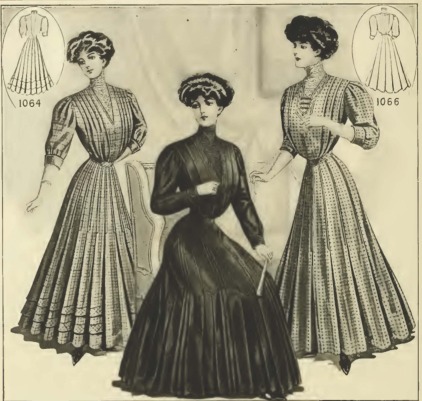
No. 1064
A stylish dress is needed by every woman, and this model will respond to fashionable indoor or visiting service.
The Waist is tucked on the shoulders, with tucks arranged at the center of the back, where the closing is made. The front is shaped in a V, revealing a lace chemisette topped by a high stock. Buttons ornament the plastron front, and turn-back cuffs give a neat finish to the elbow sleeves; the belt is removable. Long sleeves may be had if desired, without extra charge.
The Skirt has thirteen gores, in side-plaited effect, stitched to a little below the hips and falling into deep plaits. Two folds of the material constitute the trimming.
No. 1065
Straps and buttons are cleverly combined on this chic costume, and all of the season's latest essentials are embraced in its shaping, making it one of our most attractive suits.
The Waist exhibits a tucked cloth vest in chemisette outline. The popular Gibson plaits are employed on the shoulders, and the full length sleeves are trimly completed with regulation band cuffs. The stock collar is ornamented with a tab; the belt is removable. Closes in back.
The Skirt has eleven gores with alternate gores formed of short panels and inverted plaits, the desired flare being obtained by side and full length box-plaits.
No. 1066
The charm of this exclusive design is emphasized by the introduction of straps and buttons as embellishing features, and it embodies the choicest requirements of style.
The Waist exhibits tucks in front and also at the back, and conventional cuffs finish the graceful elbow sleeves. The chemisette and collar are developed in lace, and a stitched band of the material with decorative buttons, provides the elaboration. A separate belt is included. Closes in back. Long sleeves may be had if desired, without extra charge.
The Skirt consists of ten gores with two box-plaits in front, and eight side-plaits which are stitched to a little above the knee, below which the fulness sets in plaits.
Saturday, November 19, 2011
Edwardian Era Ladies' Dresses - 1903 Spring/Summer Boston Store Catalog
#887. Women's Separate Skirt of Eamine, made in nine-gore flare; trimmed with cluster tucks and taffeta silk. colors, blue and black. Price, $10.00.
#398. Women's Separate Skirt of cheviot cloth; seven-gore flare; percaline lined; trimmed around bottom with three rows of taffeta silk, and interlaced silk band ornament. Price, $5.98.
#886. Women's Etamine Separate Skirt, with percaline drop; made in seven-gore flare; trimmed with three bands of taffeta silk down front and over hips. colors, blue and black. Price, $4.98.
#869. Women's Separate Skirt of fine quality voile, made in the new shirred hip effect; trimmed with three clusters graduated tucks. colors, blue and black. Price, $13.98.
#409. Women's two-piece House Dress of fancy stripped Sea Island percales; cluster-tucked waist; Bishop sleeves, button cuff. Seven-gore flare skirt. Sizes, 32 to 42. Price, 98c.
#228. Women's Separate Skirt of all-wool homespun, made in seven-gore flare; trimmed with band of taffeta silk. Colors, blue, gray and black. Price, $2.98.
#890. Women's Separate Skirt of fine quality Etamine, made in the newnine-gore flare effect; trimmed with clusters of tucking and band of taffeta silk down the two front seams; silk drop lining. colors, blue and black. Price, $12.00.
#199. Women's two-piece House Dress, with all-over tucked waist and sleeves; button cuff to elbow; high roll collar. Seven-gore flounce skirt. In light fancy colored stripes. Sizes, 32 to 42. Price, $1.25.
#819. Women's Separate Skirt of broadcloth; percaline drop; seven gore flare; inverted plait bottom; trimmed with taffeta silk. colors, blue, black and castor. Price, $6.98.
Tuesday, October 25, 2011
Edwardian Era Ladies' Dresses - October 1902 The Delineator
Figure 130G - Ladies' Costume.
Black-and-white braid gives an effective garniture in this tailor gown for the development of which blue faced cloth was used. At the back and sides the jacket fits comfortably close, while the fronts close invisibly and are extended to form a tab, a similar effect being given in the back. A peplum lengthens the jacket at the sides, and sleeves of regulation coat shaping are introduced. Above the closing the fronts shape revers that meet the ends of the rolling collar.
The five-gored skirt has a habit back and is appropriate for short sweep or round length. A graduated circular flounce with trimming bands is a fashionable feature of the mode, and from beneath the flounce the skirt should be cut away.
Mode broadcloth with velvet collar and cuffs would give good results Coronation-red cheviot is also fashionable and an elaborate effect may be achieved with Persian trimming. Velvet suits are also made up in this way and will be smart in dark blue with a white lining.
Figure 131G - Ladies' Costume.
Tailor suiting in a fancy mixture was appropriately used for this gown, with novelty fibre braid in black-and-white for trimming. The skirt is a five-gored flare type, with an inverted box-plait at the back. It may have a medium sweep or be cut off in dip round length, according to preference, the flare at the lower part being heightened by the addition of a graduated circular flounce from beneath which it is advisable to cut the skirt away.
Snug adjustment at the sides and back identifies the jacket, which may have a fly or visible closing. A rolling collar of velvet finishes the neck and forms notches with the ends of lapels arranged above the closing. Turn-back cuffs are a feature of the sleeves, but they may be omitted.
Hunter's-green hop-sacking with a collar of velvet will make a pretty suit, and a lining of self-colored silk or satin may be added. Black broadcloth is fashionable, and folds of glace taffeta will give distinction.
Friday, July 22, 2011
Edwardian Era Ladies' Dresses - 1907 National Cloak and Suit Company, New York City
No. 1034... $16.00 up
A charming costume is presented here, and for exclusive street wear it has few equals.
The Jacket, which is single-breasted and half loose-fitting in front, closes under a fly, and the tight-fitting back can be made in any length up to 24 inches for the prices quoted below. Straps of the same material in conjunction with plaits furnish the embellishing features, and inlays are added of silk or satin.
The Skirt includes eleven gores, with each alternate gore consisting of pointed panels lengthened by inverted plaits. The desired flare is produced by box and side-plaits.
For prices quoted Jacket will be lined throughout with Good Satin; Skirt unlined.
No. 1035... $17.50 up
The symmetrical lines of this beautiful model give grace and slenderness to the wearer, and it is a great favorite this season.
The Jacket, which can be made in any length up to 30 inches in the back for the prices quoted below, is tight-fitting, with rounding cutaway edges in front. Lapped seams with tailor stitching provide the finish. The vest device can be made of silk, satin or velvet, decoratd with garniture.
The Skirt has seven gores with three plaits at each seam stitched to above the knee, where side-plaits are formed. Two folds of the material decorate the lower edge.
For prices quoted Jacket will be lined throughout with God Satin; Skirt unlined.
No. 1036... $14.50 up
The original charm of the youthful Prince Chap styles is preserved throughout in this handsome tailor-made suit.
The Jacket is double-breasted, with a visible button closing, and in semi-fitted effect in front and also at the back, which can be made in any length up to 27 inches for the prices quoted below. A velvet inlay decorates the notched collar and flaps conceal the mannish pockets.
The Skirt consists of nine gores disposed in side-plaits, stitched to a slight distance above the knee, and two folds of the material supply the trimming at the bottom.
For prices quoted Jacket will be lined throughout with Good Satin; Skirt unlined.
Saturday, April 30, 2011
Edwardian Era Ladies' Dresses - Museum Originals
A selection of links to museum originals -
1908 Purple Silk Dress - Whitaker Auction
1900 Green Velvet Suit - Whitaker Auction
Close-up of Front
1905 Winter Walking Suit - Whitaker Auction
Close-up of Front
1900 Two Day Dresses - Whitaker Auction
1905 Printed Silk Gown - Whitaker Auction
1905 Afternoon Dress belonging to Grandmother of JFK - Whitaker Auction
1914 Black Velvet Walking Suit - Whitaker Auction
Your comments about dating, fabrics, construction methods, etc. are most welcome!
Monday, March 21, 2011
Edwardian Era Ladies' Mourning Outfits - March 1905 The Delineator
Edwardian Era Ladies' Mourning Dresses - March 1905 The Delineator
Styles in Mourning Attire
In fashioning mourning garments the same modish lines that characterize ordinary dress should be observed, with individual taste and needs the first items to be considered.
Soft, pliable materials such as henrietta, cashmere, cheviot, serge and eudora cloth - the last a fabric similar to henrietta - lend themselves charmingly to the present graceful styles. Frequently the only trimming employed is self folds, tucks or plaits, though crape folds and bands are used with smart effect.
The popularity of crape, both for trimming and making entire gowns, has increased, and those who follow Fashion closely will provide at least one crape gown for the mourning outfit. The crape now used has attained comparative prefection in finish and lightness of texture, and even the crape veil is no longer objectionable, though it is rarely worn over the face. A young woman, except a young widow, may wear a crape hat, or one of dull-finish silk trimmed with crape or silk folds or rosettes.
For the correct street costume, a light-weight dull-finished broadcloth or cheviot is the best choice, and it is made in two-piece style with coat and skirt. An accompanying shirt-waist or blouse may be made of dull-finished silk or of some of the soft woollens. Dull jet buttons give a pleasing finish, while at neck and wrists there should be fine white linen collar and cuffs, daintily hemstitched. The coat of this street costume may be in any becoming length, from the Eton or bolero to the three-quarter garment. The tailor skirt in comfortable walking length is the correct mode.
8133 - This smart shirt-waist costume is adaptable to both silk and wool goods. Wide tucks are its distinguishing feature. The shirt-waist may have a military or coat closing, and the five-gored skirt has tucks stitched to yoke or flounce depth.
8089 - Grace and beauty mark this tucked costme, which may be in any one of several lengths. The bodice may be made with high neck and chemisette or with round neck, and the sleeves in elbow or full length. The five-gored skirt is tucked vertically at the top and horizaontally around the bottom. A soft material is suggested for its development.
8158-8180 - This toilette will be especially becoming to slender women, and is developed in dull-finished silk combined with crape. The bodice is in surplice style, and has Tuxedo collar bands and a shaped girdle. The sleeves are puffed. The nine-gored skirt is rippled below the hips, and may be in round, short round or instep length. An inverted box-plait or habit back is provided.
8117-8174 - This is an extremely modish street toilette. The shirred blouse jacket may be made with regulation or revers front. The yoke gives a becoming long-shouldered effect. The four-gored skirt has tucks at each seam in inverted double box-plait effect.
8148 - A separate dressy waist is essential to the completeness of a correct mounring outfit, and the one here shown is especially atractive for development in a soft material associated with a contrasting one. The neck of this plaited surplice bodice is designed to be high or in Dutch pointed style, and elbow or full-length sleeves may be used. Tuxedo revers are added, but are not indispensable. This bodice may accompany a variety of skirts.
8169-8156 - The shirt-waist and skirt sombined in this toilette show the prevalence of tucks in the season's fashions The fronts of the shirt-waist are tucked, a box-plait effect resulting from the arrangement of the tucks at the centre. A plain back and bishop sleeves finished with narrow bands complete the mode, which is alike adapted to woollen, silk and wash fabrics. The skirt consists of a seven-gored upper portion tucked at each seam and lengthened by a gored side-plaited flounce. Round, short-round or instep length may be given.
8036-8132 - The simple effect of this toilette is its distinguishing characteristic. The tucked bodice closes at the left shoulder and side, and the neck may be high or in low round or Pompadour effect with or without the chemisette-yoke. Three-quarter or full length sleeves may be used. The skirt consists of a five-gored foundation and two shirred or gathered seven-gored flounces. Tucks are introduced at the edge of each flounce.
8048 - Another very pretty bodice is distinguished by a plaited bolero. A shallow pointed yoke may be added, and the sleeves are in short puff, elbow or full-length style. This bodice will be effective in a combination of materials.
Subscribe to:
Posts (Atom)